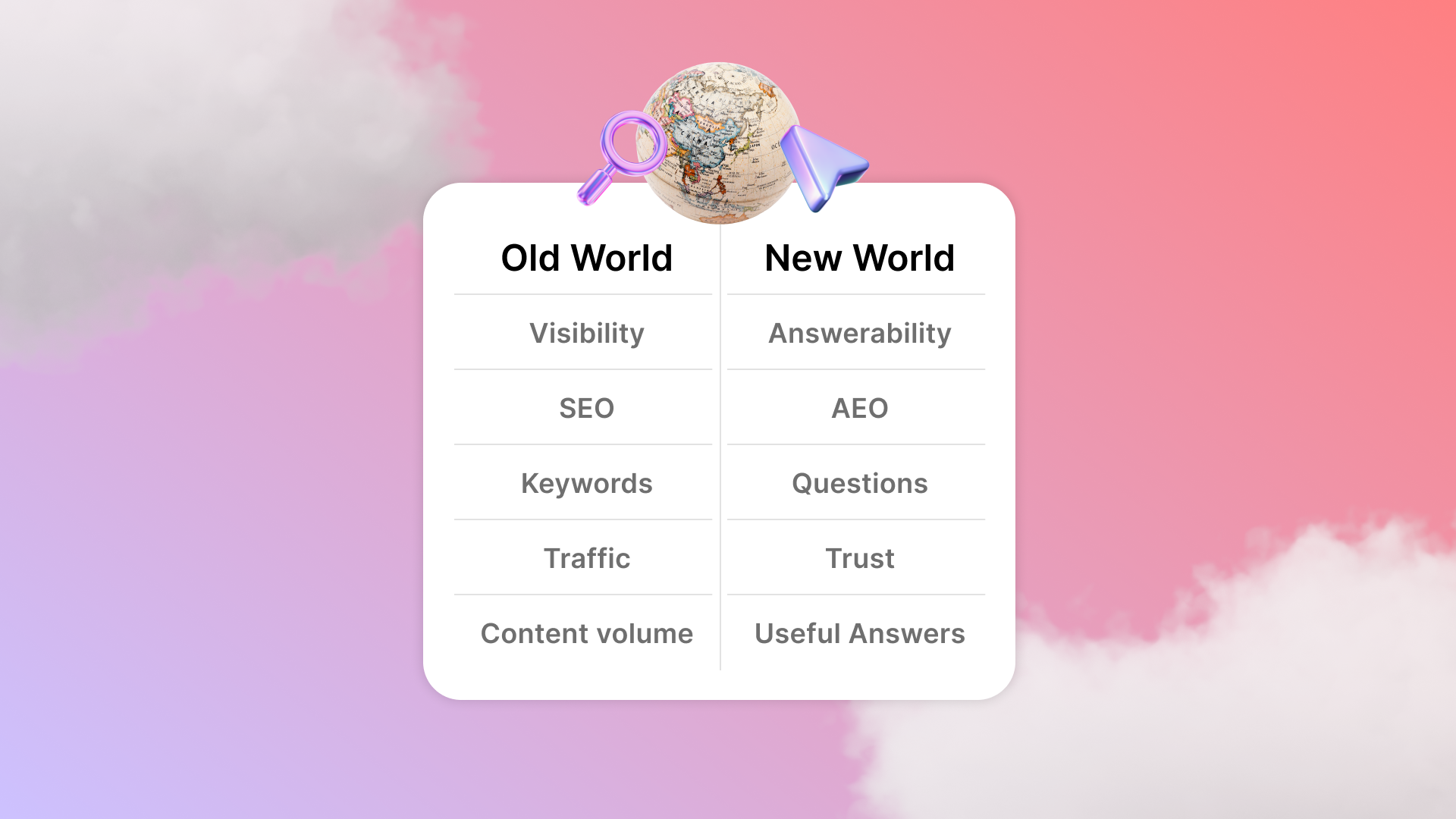
For years, destinations have been told the same thing: create more content, optimize for search, and if a page drives traffic, keep it live.
That playbook worked in a world where travelers clicked through multiple links, compared sources, and stitched together their own answers. Even if something was slightly outdated or incomplete, the traveler could fill in the gaps.
That is no longer how trip planning works.
Travelers are not just searching anymore. They are asking. And increasingly, they are asking AI.
In fact, research from Phocuswright shows more than half of travelers are already using AI tools at some point in their trip planning process. This is not a future behavior. It is already reshaping how decisions are made.
Instead of typing a few keywords, travelers are describing what they actually need.
Where can I park near the main attractions without walking forever?
Is this area safe at night with kids?
What is actually worth skipping if I only have one day?
These are not clean, keyword-friendly queries. They are layered, specific, and rooted in real decisions. And they expose something that most destination strategies have missed.
The gap is no longer about content volume. It is about whether your destination can answer the question at all.
The industry is starting to talk about GEO and AEO, generative and answer engine optimization. It is easy to assume this is just the next version of SEO. Another framework for ranking. Another set of tactics.
It is not.
SEO was about being found. GEO is about being useful.
AI does not retrieve pages the way a search engine does. It assembles answers, pulling from sources it trusts and piecing together a response in real time. If your content does not clearly and directly resolve the question being asked, it is far less likely to be included.
At the same time, platforms like Google are already changing how results are delivered. Early data shows that AI-generated answers can reduce traditional click-through rates by nearly 50%, compressing the number of sites a traveler actually visits before making a decision.
This is where many destinations are falling behind without realizing it. They are not invisible. They are simply not answering what travelers are actually asking.
There is another layer to this shift that is even more uncomfortable.
The traditional SEO rule of keeping high-performing content live as long as possible is now working against us.
For years, it made sense to keep pages active if they were driving traffic. Even if they were a bit outdated, the logic was simple. Traffic is a signal of value.
In an AI-driven world, that assumption breaks down.
AI does not know your content is outdated. It only knows that it exists. If an older page still contains relevant keywords or partial information, it can still be used to generate an answer.
That means outdated content does not just sit quietly on your site anymore. It gets surfaced, interpreted, and presented as current.
Closed restaurants can still appear in recommendations. Old parking rules can be presented as fact. Seasonal details can linger long past their relevance.
What used to be a minor content hygiene issue is now a visibility and trust issue.
In an AI-driven world, outdated content is not neutral. It shapes the answer.
And once that answer is wrong, the traveler does not know it came from outdated content. They only know the experience did not match expectations.
This creates a new problem for destinations, but it also unlocks a fundamentally new opportunity. For the first time, destinations can see exactly what travelers are trying to figure out in real time, not through surveys, page views, or constrained search queries, but through conversations.
This is why AI on your website is no longer just a consumer experience upgrade. It is a listening layer.
It is also the one place where you have full control over how your destination is represented in an AI-driven world.
While external AI systems assemble answers from across the internet, often pulling from fragmented or outdated sources, your own AI experience allows you to define what is accurate, current, and worth recommending.
That makes it the most direct way to shape how travelers understand and plan their trips.
Most destinations today still rely on indirect signals. Engagement metrics show what people clicked. Search data shows what they typed, within limits. Surveys reflect what people remember after the fact.
None of these capture the full context of what a traveler is trying to solve.
Conversations do.
They show intent in its natural form. Multi-part, sometimes messy, and often revealing far more than a single query ever could.
If you do not have a way to capture those conversations, you are operating with an incomplete picture of what travelers actually need. And in a world where AI is shaping discovery, that gap matters.
At the same time, a new category of tools is emerging to help destinations understand how they are showing up beyond their own channels. Platforms like Bonafide analyze how destinations appear across large language models, highlighting where answers are incomplete, inconsistent, or missing altogether. Together, these two views create a far more complete picture of where you are falling short and where you can lead: what travelers are asking you directly and how AI is representing you externally.
Because GEO and AEO are not just about optimizing existing content. They are about understanding what needs to exist in the first place.
At Visit Anaheim, this became clear almost immediately.
Once traveler conversations were visible, a pattern surfaced: parking.
Questions like “Where can I park near the main attractions without walking forever?” were not edge cases. They were showing up repeatedly in real traveler conversations.
Not just where to park, but how far it is from key attractions, how pricing varies, when lots fill up, and what alternatives exist.
This was a high-frequency, high-friction question sitting directly in the decision path.
The destination had plenty of content overall, but it did not have a clear, structured answer to this specific need.
That is the difference between having content and having answerable content.
Without a clear answer, the AI has to piece together something from fragmented sources. The result is often incomplete or inconsistent. And in that moment, the destination loses control of the narrative.
What conversations reveal is not just what is missing. They reveal what is unclear, outdated, or buried, and they show you exactly where travelers are getting stuck.
This changes the role of content strategy in a fundamental way.
Instead of starting with keywords or campaign themes, destinations can start with real questions. They can identify where travelers are hesitating, what decisions are hardest to make, and what information is hardest to find.
From there, content becomes more focused. Not more volume, but more precision.
Answers that are structured, current, and directly tied to real decisions.
It also changes how quickly destinations can respond. Patterns that used to take months to uncover through traditional analytics can now be identified in days, creating a much tighter feedback loop between traveler behavior and content decisions.
The destinations that win in this next phase will not be the ones that simply produce more content or adopt new terminology.
They will be the ones that listen intently.
They will treat traveler conversations as a primary source of insight. They will update content based on real questions, not assumptions. They will recognize that visibility is no longer about just showing up, but about being trusted to answer.
According to McKinsey & Company, 71% of consumers expect personalized interactions, making it even more critical for destinations to understand traveler intent at a deeper level.
Travelers are already telling us exactly what they need.
The question is whether we are set up to hear those signals and whether we are willing to build around them.
Because in the end, destinations do not lose visibility because they lack content. They lose it because they are not answering the questions that matter most.